Tuesday, May 10, 2011

Ireli and Kundu, Dogon Country, Mali

The children are well used to tourists here and rush up to you to hold your hand and ask how you are in French. In no time at all they are asking for money. It's like a game that the little ones learn from their older brothers and sisters.


It seems a tradition, when we leave a village, that someone accompanies us to the edge of the village. If there are a few men doing this they take our bags and this bid us a safe journey. The women are too busy for such traditions. They are up early and off to the village well or pump to get the day's supply of water carrying between 15 and 20 kilos on their heads.

The little girls start quite young carrying things on their heads as they copy their mums. They also spend a lot of the day carrying their baby brother or sister on their back as the mum is out working in the fields. We have seen five year olds with a baby strapped on. We could never imagine our kids doing this or walking the long distances that the African kids walk.


These carved log ladders are often well decorated and used to reach the top of the granary or to get to the flat roof where the grain is left to dry.


The granaries sit up on rocks to protect them from vermin while the thatch protects the roof from erosion and water damage during the rainy season.
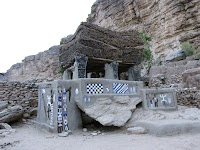


Seydou took us around Ireli village and showed us some of the sacrifice sites and where the men hold their meetings. The mud buildings were colourfully decorated unlike the others we had seen in the earlier villages.


This old man was busy weaving cotton cloth. He wanted money to have his photo taken. Another group were killing a pig to take to market and charged Chris for his photos.


There are some microfinance initiatives operating in the Dogon area. The locals can borrow at 5% interest over three years and this enables some people to buy a cow, grow crops, or set up a small stall.


On the walk from Ireli we passed a small pond full of sacred crocodiles. We saw a few noses breaking the muddy surface of the water but many had gone into the hills to find water there. The rest of the walk we passed through mounded millet fields waiting to be hoed for the next season's crops. The wind was up and blew dust everywhere.


We stopped for lunch at Ibi village. It was a small quiet place with very little happening and not many tourists stop here. The restaurant workers had to go around the village shops looking for drinks for us. They didn't keep any supplies on hand as they needed the money for their daily needs. A group of about thirty local women gathered under a tree in the restaurant compound and a man was talking to them. Several of them had small children or babies on their back and a few were obviously pregnant. Seydou told us the man was a community health worker and was trying to discourage the women from circumcising their daughters which is the tradition here. He also gave the pregnant mothers free mosquito nets for their babies. It seemed so odd to see a man talking about such subjects to a group of women as we would use a female. But in this society they are used to having to listen to the mens' advice.


Chris went wandering and met a few locals. After a rest here to wait out the hot midday sun we headed for Kundu.


We climbed up through a rocky pass for about three hours. There were a few old men and women collecting firewood on the way. We gave them the last of our kola nuts for which we received wide smiles and a handshake. At the top of the pass was a man setting a trap for genets that hunt at night.


Kundu was a small place too and quite like a fairytale land with its granaries close together. We settled into a guesthouse just before dark. The lukewarn soft drinks we had were very expensive. They had a solar panel to provide light for us on the roof. We had a cool bucket shower and after dinner we moved the tables to put down our mattresses to sleep the night.


In the night there were a couple of small spits of rain, which John and Chris slept through. The next shower had drops big enough to wake us all and become annoying so we packed our beds up and moved downstairs into a room. It was so hot we had trouble sleeping the drizzle had stopped but we were too tired to bother to return to the roof again.


In the morning after a breakfast of fried bread and tea we headed for Sanga where we were to be picked up.


The temperatures on the rocky escarpment that we walked along to Sanga must have been between 45 and 5o degrees in places as it was so hot. We could look down from Sanga to the villages we had left behind.


As we neared the outskirts of Sanga, we herad children shouting. In no time they had gathered their welcome band together and were using plastic drink bottles and empty plastic jerrycans as drums. Some had strips of paper around their waists and paperbag masks on their heads. They had created their own mask dance to collect money off the tourists. This was a town used to tourists and the centre of a few travel and guide organisations. We had lunch here and then headed back to Sevare to stay a night and pick up our stored luggage.


Tireli, Dogon Country, Mali


In Sevare we bought some kola nuts to give to the old people we met during our walk. The kola nut was originally used in coca cola and is yellow, pink or red coloured. It is an appetite depressant and a mild stimulant. Sometimes the old folk asked us for the nuts and at other times we greeted them and gave them some which they accepted with a wide smile.


Dogon villages are set out to a traditional pattern. The family compound has a courtyard and rooms for the parents and young as well as granaries, linked by stone and mud walls. Children from around seven to nine years live in a childrens' home in the village. Single sex dormitories are constructed for those who have been circumsised but not yet married. The granaries are only used by the women and contain grains as well as jewellery or other items the women wish to store. The graneries look like plasticine pepperpots giving the villages a fairytale look.


There is a maison de regles or menstruating house for women to go to when they have their periods. Older women are with them to give them traditional medicines or advice if needed.


There are altars for sacrifices and other ritual sacred places. The Togu-na or case a palabres has a low roof with eight pillars. It is a place where the men meet to discuss and listen to problems that there may be and then they decided on solutions or mete out justice as they think right. The low roof helps the discussions calm as an angry person cannot stand up.


The mud covered buildings have to be replastered every year as the rains erode them. A mix of mud, dung, and a plant oil is used to help waterproof the coating.


The baobabs looked very strange as the bark is stripped off to make rope and even with such scarring the tree still survives.


Under the escarpment cliffs are the remains of the houses built by the Tellem people who lived here before the Dogon. Although the buildings are high up in the cliffs they would have been reached by rope ladders or from the tops of the tall forest trees that were around at the time. Today there is very little forest and the desert is taking over the plains below the cliffs. The old Tellem houses are now used by the Dogon for burials.


The guesthouse at Tirelli was a treat as it had a petrol powered fridge and we were able to have cold drinks. It also had a shower attached to a 44 gallon drum and a western style toilet. The owner was a Catholic man with nine children and had recently moved from his smaller hose to the present one where he could fit everyone in and have enough accommodation for the tourists. The ornate carved doors tell the history of the Dogon people and are now a sought after tourist souvenir.


A Korean film crew arrived for lunch at the guesthouse and had paid the village to see and film the masked dancers that the Dogon people are famous for. We were allowed to watch as well as long as we stayed out of the way of the Koreans and paid a small fee to the village. We went into the town as it was market day and then watched the dancers.


The drummers


The stilt dancers


One of the masks in the form of a prostrate serpent can be ten metres high. Some of the other masks resemble goats, rabbits, cows and other animals.


The French government has issued warnings on its advisory site against travel to Mali. They say that there is some Al-Quaeda activity in the country but from what we can make out, France wants to return some Mali refugees but wants Mali to pay for their repatriation. The Mali government doesn't want to pay. As a consequence, there is a drop in the number of French tourists coming to Mali and it looks like it will continue for as long as the warning stays on the French site and is added to other government sites.


There is a large French built tourist complex opposite Tireli village and it looks like it will empty for quite awhile.

Monday, May 9, 2011

Nambori Village, Dogon Country, Mali

Dogon Country is a UNESCO site because the Dogon people moved to the Badiagara Escarpment in the 13th and 14th centuries from the west of Mali to escape Islam and the Fulani armies. The area is rich in the animist culture having complex traditions including cosmology.


We passed several baobab trees along the walk and this one had a beehive propped up in its branches.


After walking through a small village we descended through a narrow section in the rock and down into the valley. In the village the children rush up calling 'Baboo' (whiteman) and after greeting us with 'Ca va' (hello in French) stick their hand out for a gift (cadeau), or bic (pen), or bonbon (sweet). Some want to hold hands and walk along with you but the guide shoos them away.


A meeting place.


The Dogon people live beneath the escarpment but in some places they also live above it.


Nombori is the village where our guide Seydou was born, and our first stop for the night. When he was living in the village he was an animist. As a child his job was to look after the families' animals. When he was sixteen he decided that he would like to be a tourist guide. He had very little education but moved to the city where he learnt English and some Italian when he worked for an Italian tour company. He now belongs to a guiding association and does very well guiding.


The Dogon people have a traditional greeting exchange that goes on and on. As Seydou knew many people in the area he was stopped all the time and had to go through the whole ritual. It goes something like this:


The person greeting Seydou : Hello


Hello


How are you?


Good


How is your mother?


Good


How is your family?


Good


How is your work?


Good


How are your clients?


Good


Then it is Seydou's turn.


How are you?


Good


How is your husband?


Good


How are the children?


Good


How are your parents?


Good


How are the animals?


Good.


Then they exchange some news. Sometimes Seydou would greet a group working in the fields or passing us on the road and then the exchanges are like a chant where they all reply in unison.


We stopped at a guesthouse in the village and after a bucket shower we drank tea and they prepared a meal of couscous and vegetables in a tomato sauce for us. The guesthouse was made of mud with an open area where we ate. Only five members of the family lived in the house but locals wandered in and out all the time. After the meal Seydou told us some dancers would come later and dance. They cleared the courtyard and turned on the solar powered lights.


We expected a few people but I counted forty women. Most were dressed in their homemade cotton and indigo-dyed clothes.


The women who danced had a whistle in their mouth which they blew as they danced towards the male musicians. This woman had a sleeping baby strapped to her back who vibrated up and down as she danced. I wondered about our 'Never shake a baby' campaigns, and if this baby would be affected as a result of the vigourous shaking it got from its mother.


The men played different kinds of drums and when the women finished their dance they touched the ground in front of the drummers. The man with the biggest drum rolled his drum towards a woman if he wanted her to dance again. On the ground, in half a calabash, is some millet beer. The women had one that was passed around amongst them while the men had their own. It is not a strong alcohol and is served at room temperature. Chris really enjoyed it as it reminded him of 'real ale'.


Of course we all had to dance as well.


As we danced the women sang and clapped. There was only one song and the same dance the whole night.


A woman places her scarf on the man's neck and after the dance he has to find whose scarf it was. At 10 pm we all danced in a circle to end the evening. There were a few children watching and they enjoyed using Chris's camera to take photos of themselves and then laugh hysterically as they saw themselves on the screen. It was a great evening and if we hadn't been there it would have still been an evening where the locals got together and enjoyed themselves. Seydou left us in the evening as he went home to see his mother and as far as we knew it was not arranged especially for us.


We clambered up a narrow log ladder to mattresses on the roof where we slept the night. The stars were out and we could hear the dancers chatting as they headed home by torch light. As we were dropping off to sleep we could hear drums chanting and drums in the distance.


In the morning Seydou told us it was a male circumcision ceremony that we could hear and they are held every three years. The women are also circumcised in Dogon.


In the morning we had the bread that Seydou had brought from Sevare along with jam and tea.


We had time for a quick visit to the local museum and then headed off towards Tireli.

Sunday, May 8, 2011

Sevare, Mali

We had ordered a taxi, through one of Anette's numerous contacts, to pick us up at 5.30 am. He was on time but our bus didn't leave until after 7 am. It was typical of the Mali buses with no opening windows and no air-conditioning. As the day warmed up it got really hot and we were able to get some free bags of water from the conductor as we had drunk all that we had brought with us in no time at all. We haven't been able to check the temperatures but it is the hottest time of the year in Mali and it is not the best time for tourists. We think it is around the early 40 Degs.


The bus had problems with a fuel line and the young men that load bags, collect money and do other jobs about the bus, had to suck the lines clear of debris. They seem to be able to turn their hand to fix anything that goes wrong with the bus and are always covered with grease or dust. When they are on routes where they see a lot of foreigners they get good at communicating basic information and seem to understand what you ask even though they don't speak any English.


Anette recommended an English speaking guide in Sevare so when the bus arrived he was there to meet us. He had a 4x4 and a driver and took us to a hotel a short distance from the bus station where we had decided to stay. Someone in Bamako had suggested the place. We negotiated the rates for our planned walk in Dogon Country, for Chris and the two of us.


We were able to leave our excess baggage at the hotel as we would return there after our walk and just needed to pack our small day bags. Our guide would carry some of the canned food we would need and the rest would be provided by the guesthouses on the trail. As there is no electricity in most of the villages we decided to eat vegetarian meals to avoid any upset stomachs.


In the morning we started out at 7.30 and the drive to Bandiagara where the walk would begin was on a bumpy dirt road. If we had taken public transport we would have had to wait for market day in Bandiagara when several vehicles would travel from Sevare to Bandiagara. As it is the quiet period for tourists we had to hire the vehicle and driver. Our guide Seydou belongs to a guide organisation that has several 4x4s so it was not difficult for him to get a vehicle to take us and meet us at the end of the walk to return to Sevare.


Along the route were a few terraced fields of onions or shallots. There were a few fields with chopped up millet plant stalks where the animals were feeding. At the same time they feed they get to fertilise the fields with dung. It is about a month away before the villagers prepare the fields for planting just before the rains begin.


Some of the road was paved with local stone and in steep sections or fords it was concreted making it easier for the cow carts and donkey carts to pass in the wet weather.


We were dropped at Dourou village, population 4,000, where we had traditional African tea and lunch. The tea is made from Chinese green tea leaves. The leaves are stewed in a small teapot on charcoals for about 15 minutes. Heaps of sugar is added and then poured back and forth from the small glasses and the teapot. This soon foams up and then it is drunk. Water is added to the same leaves and it is stewed several times more giving the tea a strong bitter taste. Men sit in the shade or in front of their houses with friends drinking tea all through the day. For lunch we had a can of vegetables heated with spaghetti noodles. After eating, we rested until the weather was cooler in the middle of the afternoon and started our walk.


Saturday, May 7, 2011

Bamako, Mali

Had an uneventful bus ride from Banfora to Bobo-Dioulasso where we spent a night. Headed off at 6am to the bus station to catch a bus to Bamako in Mali.


Drove through a large rice paddy area and saw lots of fields of vegetable crops which we have not seen before in Burkino Faso.


At the Mali border the customs officials wanted to sell us a visa and didn't seem to recognise the one we had got already. After some broken French we were stamped into the country. There wasn't an office and we sat on a bench under a mango tree to do the official paper work.


The Malian bus had a few empty seats and we were lucky enough to get behind the driver who had an open window as the bus air conditioning units no longer worked. The windows in the bus were all sealed and so the only air getting in the bus was from the two roof vents that were opened above the aisle. it was so hot and smelly, even the locals were dripping with sweat.


The road was pretty bad with lots of potholes and speed humps and the toll booths and security checks added time to the slow trip. We also lost an hour and a half when we blew out a tyre and had to get two tyres repaired in Segou on the banks of the Niger River.


After 14 hours we arrived in the dark on the outskirts of Bamako. With another passenger from the bus we got a shared taxi to the Catholic guesthouse we wanted to stay at. The guesthouse had rooms around a courtyard that was full of vehicles belonging to the nuns and some other travellers. There were no double rooms but I was able to get a bed in the female dormitory while John got one with the men. The nuns were very welcoming.


We had had an email from our Brit friend Chris and were planning to meet him at the guesthouse. The nuns told us he was around but we never saw him until later in the day as he had been to listen to music. The clubs start about 9pm and don't close until early morning so he was out and about with people he had met at the club. When he was not in his room the nuns became worried about him and were most relieved when they finally saw him. It was such a caring and welcoming place.


Across the road from the guesthouse was a vegetarian cafe so we were able to get something to eat without having to go far. The street outside the guesthouse was dusty and full of people sitting under the trees chatting or sitting in front of their shops chatting. A small stall had a TV blaring with lots of the locals on benches in front of it watching soapies. Kids ran up and down playing in the street as well. As we ate hawkers came by trying to sell us their wares.


The streets are full of rubbish. Everyone walking on the street tosses their rubbish onto the road or on the floor in whatever shop they are in. Once a day the shop owner sweeps out the shop and leaves the rubbish on the street/footpath or into the uncovered drains. If there is a kerb and channelling the rubbish is swept there. Stretsweepers who are up and about in the early morning only sweep up some of the road rubbish and leave the drains etc. We saw some shop owners pay young boys with carts to sweep out the kerbs and drains in front of their shops. The boys then take the rubbish to an empty section or piece of land near the main highways or railway lines and dump it. There doesn't seem to be a citywide rubbish collection service nor any designated rubbish dumps. Consequently the drains fester with green-black gunk and the huge rats come out at night to scavenge. Bamako is the only place we have seen rats so far!


After one night in the dorm we were able to move into a room with three beds, mosquito nets and a shower. We met lots of interesting people. Sara from the US was doing research on the role of midwives and had to do some interviews in the city although she was staying with a rural family most of her stay.


Anette, from Sweden and ten years older than me talked bout her travels through West Africa. She is divorced with no children and having retired four years ago decided she should take advantage of her opportunity to travel without having to worry about a husband or children like her friends. She rents out her apartment in Sweden and leases a place in Morocco that she uses as a base. She was a French and German teacher so has no problems communicating in French in West Africa and her English was excellent as well. While her friends think travel is difficult she tells them it is no different than in Sweden. She catches a bus from one city to another stops and then catches another bus to another. When she puts it that way it certainly doesn't sound any different than travel in your own country. She has travelled in West Africa many times and has a notebook full of her cellphone numbers in all the different countries. We plan to catch up with her when she is in Senegal.


These lads arrived in the old Mercedes from Portugal. On the way they convinced a Mauritanian customs officer to join them on their road trip as well. They had a long hot drive through Morocco and Mauritania to Mali and were pretty exhausted when they arrived. They only had two weeks' holiday and then would either drive all the way back or try to sell the Mercedes and then return. They were driving onto Niafunke southwest of Timbucktu to visit the home of musician Ali Farka Toure, even though he died in 2006.


John awoke on the third day to find three quarters of the white of his left eye was bloodshot. He had no pain but we decided to get it checked. The nuns sent us to a hospital but when we got there the eye clinic was absolutely crowded with patients. We phoned the American embassy and asked them if they had an optometrist on their books who spoke English. They gave us the name of the optometrist they used but as he didn't speak English we asked Anette if she would translate for John. The optometrist said the bleeding was caused by the high temperatures and after prescribing some drops it cleared the next day. John was able to have his eye pressures taken as well and they are at the lowest pressures since leaving home and in good condition so that was pleasing to know.


Chris was able to leave his excess baggage with the nuns while we decided to take ours to Sevare. After the walkin Dogon Country we would return to Bamako as we need to get visas for Senegal.


Banfora, Burkina Baso

Had a short walk early in the morning to the bus station in Bobo to catch a bus to Banfora. The bus company looked like it was doing good business as they were constructing a huge new office and bus depot.

The drive to Banfora was pretty uneventful and we passed through some of the greenest country we have seen since leaving Ghana. There were acres and acres of mango trees and in every shady spot beside the road were women with piles of mangoes for sale. They grade them into sizes and colours and all sit waiting for someone to stop and buy.

Closer to Bnafora and on the flats were acres and acres of sugar cane plantations. Some were being watered by huge irrigators. We saw a couple of steaming chimneys from the sugar mills in the distance as well.


We leapt off the bus before it reached the town centre as we had spotted a sign for a hotel that had been recommended. It was a wonderful place with small round brick thatched rooms. We had mosquito nets, a fan and an ensuite. The paint colours and tiling in the ensuite looked like they could have decorated an European bathroom, they were so modern.

There was a large open sided thatched eating area outside where we could get a free Wifi connection so were able to catch up on emails and the blog.

It was a short walk to the town centre and there was not much to see. We wanted to visit a club and listen to music but couldn't find any taxis that could get us there and back so had to abandon that idea.

These lizards are every where doing press ups.

There were not many people in the hotel altrhough it was Easter holidays. We briefly chatted to a couple of Canadian women who were with Oxfam in Ouagadougou and one was in a small village near Bobo working with women growing hibiscus flowers. The flowers are called bissap and are dried and used to make a refreshing drink.

An American professor and her son and partner were also in the hotel one night. They were relaxing after a stressful time in Ouaga. They were tired of the gunshots and the curfew and needed a break. The professor's family were originally slaves from Burkina Faso and she taught American literature at a university in Bamako and wouldn't return to the US until July.

The hotel owned a restaurant in the town and in the evenings when we ordered our dinner it was picked up from the restaurant and delivered by bike to us. There was a kitchen but we only got breakfast served from there.

It was a shame we couldn't explore the outskirts like the Canadian girls who had a vehicle but we felt relaxed and ready to head for Mali.


Bobo-Dioulasso, Burkina Faso

The taxi that took us to the bus station in Ouaga was an absolute wreck. The roof was so low we had to slink down in the seat so we could fit our head under the collapsing roof. The interior roof linings were falling down and we had to hold them up so we could see out the windows. There were no window or door locks or handles. The boot was rusty and the boot door tied with a strip of rubber tyre tube and when we hit a bump everything jumped up and down including the lid. The differential thumped and there didn't seem to be any brakes and we seemed to stop at the same time as the engine. Fortunately the taxi couldn't move very fast so we were in no danger of a hight speed crash.

The bus was a complete contrast, with air conditioning and a modern interior. It sat in a yard that kept the SIM card andmobile phone recharge sellers at bay. The DVD was terrible with lots of shouting and screaming which made the locals laugh and they seemed to enjoy.

Some newspaper articles suggested there may be robberies and kidnappings following the unrest so we hid money in our shoes and hid our photo cards in case the camera was taken. Fortunately we had no problems.

The road to Bobo was pretty good but the fields were extremely dry. We saw lots of mango trees and a few fields of onions. The few water holes were alive with cows drinking and children swimming.

We found a small hotel a short walk from the bus station and in no time we were accompanied by a wannabe guide. The town is full of guides who want to show you the old city with its potters, weavers, and blacksmiths as well as the mosque.


We could see the white painted mud mosque from the hotel terrace and watched as the locals sat under shelters outside to pray. The local village children played their own version of hop-scotch
under the trees and the guides kept trying to sign us up for a tour. Bobo has had none of the unrest that other places in the country have had so we were looking forward to relaxing there.


The 'mango rains' have arrived: short thundery storms with brief rains that swell the ripening mangoes. Luckily they came at night. The rains reduced the temperatures from the high 30s but they roze again in no time.


We treated ourselves to a pizza at a restaurant run by a Catholic Mission. It was like an oasis in the middle of sandy and dusty streets. There was a fountain in a large courtyard with lots of bushes. The tables were decorated with tablecloths and napkins and Vivaldi's 'Four Seasons' played in the background. We enjoyed ourselves so much we couldn't resist finishing the meal with a mango sorbet. This is such a change from the restaurants that sit on the dusty streets where we get spaghetti, couscous, or rice with a tomato paste sauce.


The city, although the second largest in Burkina Faso, feels more like a village. Most of the streets are dusty and unsealed but most have huge trees lining both sides. From the top of our hotel we could see how leafy the city was.


We caught up with our Belgian friend Frederik and spent most evenings together eating in different restaurants.

The market had many stalls of cassava tubers.


We were lucky enough to find a Lebanese supermarket to buy yoghurt and a few things that made a change to the usual fare found in the street stalls or local restaurants.


Both John and Frederick were happy to find a place that showed Real Madrid and Barcelona. We jammed in to a hot room with about 100 other men. They were all pretty loud when their favourite team or player did something special or were reprimanded by the referee. Once again I was the only woman and we were the only foreigners.


We had been keeping an eye on the government advisory sites online and the British site advised against travel to Mali from Ouaga so we decided to head to Mali from Bobo instead. It appears that some rebels from Niger have taken tourists near the Mali border.


Before heading off we decided to make a short trip to Banfora a short distance from Bobo.