Friday, April 15, 2011

Parakou, Benin

Had to catch a couple of motorbikes, from Abomey, about ten or eleven kilometres to a dusty square off the main highway where the large buses left for Parakou. We were greeted by men in uniforms with ticket books for several bus companies. As soon as they knew where we wanted to go we were sold a ticket and ushered to a wooden bench under a corrugated iron roofed seating area.

All around the square were small stalls where women cooked food and prepared things for sale. There were peanuts bagged up, kola nuts set out under damp hessian bags, mangoes, bananas, bread with various fillings, rice with peanut sauce, fried guinea fowl, fried chicken, fried plantain (banana), peeled oranges, and various offal from goats and sheep.


After an hour or so a bus painted in Benin Post colours and logo arrived. We were able to get a seat at the back of the bus. As soon as it had stopped the girls from the stalls surrounded the bus to sell their goodies. Only one of the windows could open on the bus so they had to rush the exit doors to get customers.


The seat we had did not have much leg room and the seat back was so soft we got a massage up our spine every time the person behind moved their bags or legs up and down. The bus would have originally had air con but it was not working so the only air we got was through the three push up vents in the roof. The two windows that did open were barely open as the locals don't like the wind and are reluctant to open the windows and then they pull the curtains across as they also don't like the sun.


The road we travelled for four hours was the best we have been on in West africa. We passed through Dassa Zoume, famous for its 41 hills of amazing rock formations. The locals sold sliced slabs of rock on the side of the road.


The north is noticeably drier than the tropical coastal areas and there are still lots of subsistance farming. Fields were being hoed into high mounds ready for planting manioc.


In Parakou, the bus was met by dozens of motorbike taxis and a couple targeted us as soon as they saw us. They wanted to charge us five times the usual rate to go to the guesthouse we wanted. We didn't take the ride and the guy ended up with no customers as the locals had all loaded up the bikes and gone.


The guest house recommended in our guidebook had been sold as a private family home so we headed around the corner to a new place that was only one year old. It was spotless and very comfortable with a very helpful receptionist who tried hard to understand our French.


There is not a lot to do in Parakou and is used as a stop-over for people going to the national parks in the north. We found a pretty fast internet place and caught up the blog, news from home and emails.


We met a local man who was born in Ghana and spoke very good English. He was the same age as John and he came to visit us a couple of times to chat. His mother was from Togo and his father from Benin.


We found Parakou a laidback place where none bothered us. There were no beggars, and no shoeshine boys. We noticed in Ghana that very few people smoked but as soon as we arrived in the French colonised countries we noticed that more and more people are smokers.


We had to get more CFA ( Communiaute Financiere Africaine - African Financial Communuity to us! ) currency here and after trying two bank's ATM's we were able to get money out. It has been so easy having countries with the same currencies and not having to worry about changing money at the border or with money changers that can be unreliable at times.


Managed to find a couple of very nice places to eat and enjoyed some fresh salads and meat without bones or ofal!

Sunday, April 10, 2011

Abomey, Benin

Caught a shared taxi from Ouidah to the outskirts of Cotonou and had to wait an hour and a half for our minibus to fill up. The driver put us in the front seat and as we filled there were three of us sitting next to the driver. The minibus seemed quite new so was in very good condition with thinly padded bench seats in the back. The road to Abomey was sealed but in poor conditions with many potholes. There were a lot of burnt out and jack-knifed trucks on the road side. It seems that drivers on both sides of the road race to get around potholes on their side of the road and when they misjudge there is a head on crash. Of course when the trucks with their long loads do it, their loads can shift and they go over. Sometimes we have seen trucks with their cabs at strange angles coming towards us but when you look at their tryes they are going parallel to the road, quite an unnerving sight. Nine kilometres from Abomey, we pulled into a small lane to drop passengers off at the Bohican market, but the driver was driving too fast. He tried to squeeze between a truck unloading maize, and a stall on the side of the lane but smashed the wing mirror. The mirror bent back and smashed the quarter light window and the whole lot ended up in John's lap. He was covered from head to toe in shards of glass and silver from the mirror. He had a few scratches on his arms and a larger one on his calf. All the local passengers got off and caught motorbikes to their next destinations. The driver and his conductor were of course blaming the truck driver for not leaving him enough room. We had paid to go all the way to Abomey and John nagged the driver to take us on. The conductor organised some motorbikes and wanted us to go on with them as we were the only passengers left and they didn't want to bother to take us. John perservered and they took us the nine kilometres to Abomey. All this was done in broken French! From the Abomey bus station we had to take a motorbike to our guest house. The guest house was a strange place. It covered a large area and had lots of buildings. There were circular covered eating areas under the teak trees and long blocks of rooms where there were several local families. There were dogs lying around the outside charcoal fire pit, an antelope in a pen, and a monkey in a cage and the staff were lounging around in different places asleep. Our room was big but quite dark as they have small windows that have wooden louvres and mesh but no glass. We had a mosquito net and a fan and were able to do laundry in the huge tiled bathroom. The trees in the garden were covered with wooden carvings and there were all kinds of carvings of fetishes with large penises under the trees. Abomey is famous as the capital of the fierce Dahomey Kingdom, who scared the heck out of the colonial powers for centuries. When the French built the rail they deliberately planned it around Abomey to avoid the kings. The last Dahomey king, Behanzin We visited the History Museum which is in a part of the king's palaces that were not destroyed by fire by King Behanzin. Each new king built his own palace so we were able to see a couple in the UNESCO site. They were a pretty bloody lot and we saw a throne that a king used where the legs sit on the skulls of four of his enemies. A lot of the history of the time is recorded in large applique hangings in the museum. Unfortunately, we were not able to take any photos of anything. The guide, we had included with our ticket, could only speak 'museum' English. She could point at things and say throne, buffalo etc. She could not answer any questions or make a complete sentence in English. A bas relief of a voodoo juju man A shrine of pots, fish bones, and animals' skulls covered with oil We walked about the town reading some of the signs telling about the history and its kings. We found a place to eat near our guest house where there were a few choices of dishes. While here we met Frederik from Belgium. He was unwell at the time and after a visit to a clinic was told he had malaria even though they didn't test his blood. He must have had typical symptoms. We spent a bit of time with him listening to his story about a girl he met in Mali and how he sent her money every month through Western Union money transfer company. He supported her for four years at unversity. He has at last come to the conclusion that her and her family were using him for the money. He was the only English speaker we met in Abomey although we saw about a dozen westerners. It is wonderful to see the locals wearing brightly coloured and patterned clothing. Sometimes a mum will be wearing the same amterial as her daughter or a dad the same as his son. Men even enjoy wearing lacy outfits (border anglais I think it is called). We have seen this dress in Ghana, Togo, and here in Benin.

Ouidah, Benin

Jumped onto the back of a motorbike and headed for the shared taxi station to get a ride to Ouidah. It was only a 42 kilometre journey so it didn't take long although there were a few checkpoints to go through.


As the guesthouse we wanted was only a few hundred metres from the main road, the taxi driver dropped us there, and saved us a walk in the heat and humidity. The receptionist could speak a bit of English so we were lucky. Of the eight rooms in the complex we were the only guests. Our room looked like it hadn't been used very much and I had to get the receptionist to come and give the bathroom a scrub while I brushed away the cobwebs on the walls and ceilings.


The yard had a disused tennis court and lots of trees. There was also a monkey tied to a mango tree who leapt down everytime he saw us come near. The poor thing couldn't swing as he was on a short chain belted to his waist. There were a couple of dogs and four puppies lolling about the restaurant floor as well and the ubiquitous chooks pecking in the dirt.


When we ate at the restaurant in the evening there were trillions of termites flying into the light and dropping all around us. It was an effort to keep them out of our steak kebabs (brochettes) and salad.


We visited the History Museum inside the Fortaleza Sao Joao Batista, a fort built by the Portuguese in 1721. The tickets included a guide but none of them spoke English so we had to try to figure things out for ourselves as there was little signage and what there was, was in French.


The fort


The display was rather disppointing in the museum, with a few artifacts and lots reproductions of early maps of West Africa.


We hired a zemi-john and drove the four kilometre Road of the Slaves. We started at Chacha Place which was the auction place for the slaves. From here the slaves were then shackled and marched to awaiting ships on the coast. Along the route are fetishes like this one.


There is also the Monument of Repentence and the Tree of Forgetfulness. The slaves were marched around the original tree to forget the land they came from.


A sign in the town

40% of the people are Christian and 25% Muslim, but most people practice voodoo whatever their religion. The Dahomey slaves took voodoo to the Americas and mixed it with Catholicism and their Afro-Brazilian descendants brought it back. The northern people practice voodoo under the name of fetishism where they have shrines. A fetish is a potion or object imbued with the spirit's power. Fetsih markets are where the buyer can get the items they need to make a concoction.


In voodoo there is a supreme god, Mawu, and loads of lesser spirits. Traditional priests or juju men are consulted as they are able to communicate with particular spirits.


A street scene

There was a python temple in the town but we didn't bother to go in as it is more like a tourist trap where they charge you to drape a python around your neck. We expected to touted by tour guides but were left alone to wander about so it was quite a relaxing place to be.

Cotonou, Benin

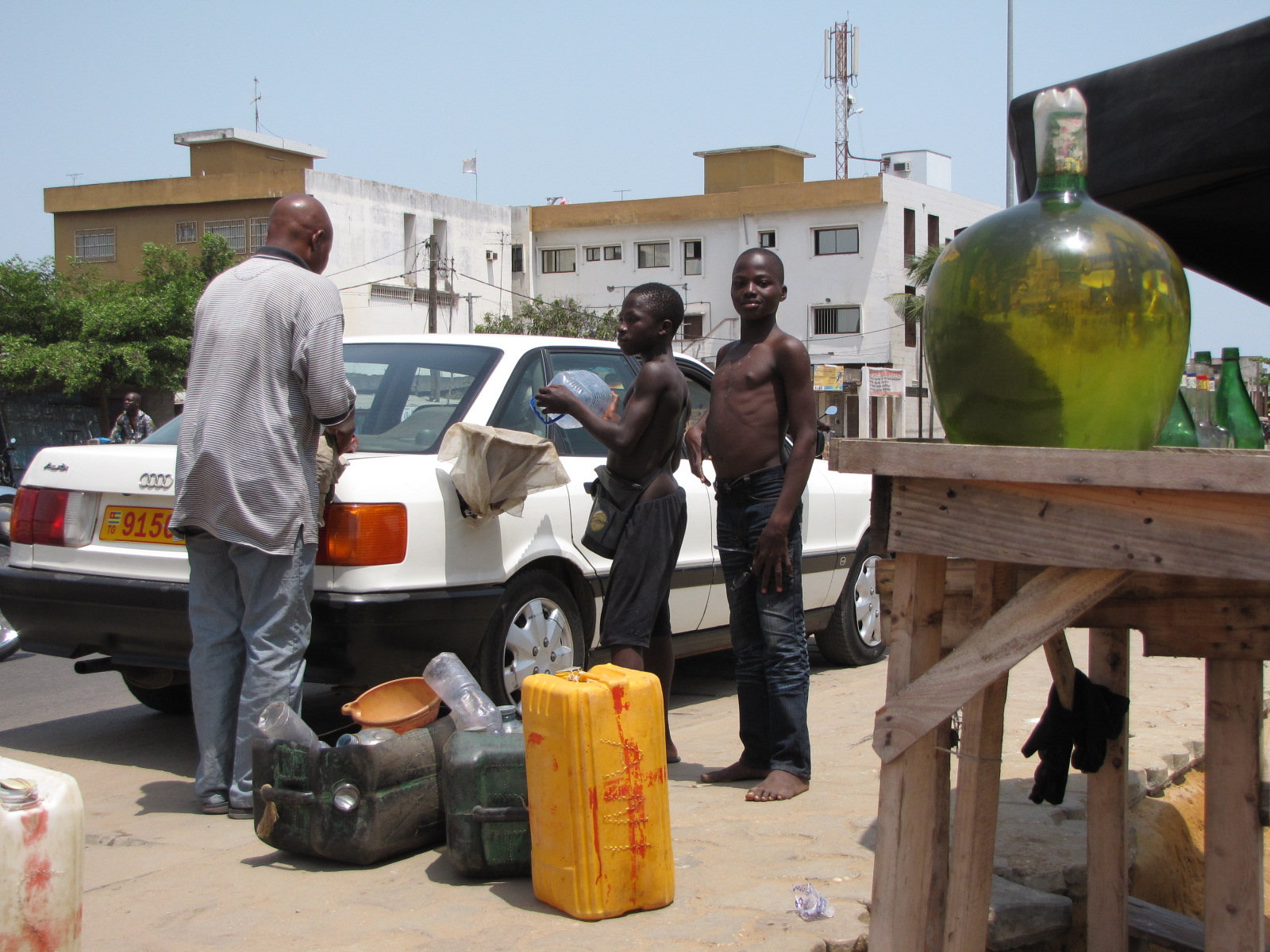
From Lome we caught a couple of motorbikes, zemi johns, to the shared taxi station. We waited 40 minutes for our car to fill and with four of us and had a pretty comfortable ride to the Benin border. There was a young student from Benin in the taxi and he had been six months in Ghana improving his English. He had studied accounting and wanted to get a good job for which he needed good English. It was great to chat with him about his life. All along the highways are stalls like this selling fuel for motorbikes and cars. Here our taxi is filling up in Benin where it is cheaper than Togo and the fuel comes from Nigeria. The funnels are lined with cloth to filter the rubbish from the fuel. Sadly many of the big petrol stations with their huge concrete forecourts are deserted as these stalls surround them and take their business. We had no problems crossing the Togo-Benin border and had a comfortable trip to Cotonou with our very careful driver. He dropped us off at the Catholic Guest House that we wanted to stay in. The guesthouse reminded us of the Soviet style residential building of grey concrete. It was four floors high and had a great view over the area. Our room was spotless with tiled floors, mosquito nets, a fan, a balcony and free Wifi. We had to do a bit of swatting of our French as the receptionists were difficult to communicate with and no one speaks English. We walked around by the beach and looked for somewhere to eat but only spent one night in the city as there was little of interest for us here too. We found a Lebanese restaurant selling shwarma and were happy to have a change from rice, chicken or pastas. During our walk into the city centre we noticed lots of beggars in wheelchairs at the traffic lights. A couple noticed us and chased us in their chairs. We have never been chased by wheelchair beggars before and it was a very uncomfortable feeling as they were a long way from us and we were crossing a median strip that they would not have been able to get over so they couldn't have caught up to us. During the night we were woken by a heavy downpour that sounded like a jet engine on the roof. John slept through most of it but I woke up as I felt raindrops on my body. The wind driven rain was pouring in the open louvres and the floor was flooded so I had to get up and close everything. It went on for about two hours and cooled the place nicely. This coast was formerly dubbed the 'slave coast', because the Dahomey kings pillaged their neighbours for slaves and land. For more than 100 years, 10,000 slaves a year were transported to Brazil and Haiti in the Caribbean. Benin is famous for voodoo, slavery, the Kings of Dahomey, and adopting Marxism.

Lome, Togo

The only transport to Lome from Atakpame was a shared taxi. We were four people across the back seat of the sedan and there were two adults and a baby in the single passenger seat in front. Luckily the road was pretty good most of the way so we didn't bump and bounce onto each other but it was extremely uncomfortable not being able to move our feet or arms. After a few kilometres, I realized the driver had started yawning and had wound his window down and was resting his arm on it, like he was getting himself comfortable to go to sleep. His eyes were very bloodshot and he dozed off, so we shook him awake. He must have made a joke to the other passengers about how we thought he was asleep and of course they all laughed at us and then dozed off themselves. It was only about nine in the morning, so maybe he had been up watching soccer on TV until late. For the rest of the journey John and I took turns to watch him in the rear vision mirror. The road was quite straight and there were no potholes or corners to provide any stimulation so it would have been easy for him to doze off again. After an hour or so he stopped and had a drink and something to eat and kept looking at us in the mirror and we at him for the rest of the trip. Along the highway we saw the wrecks of about five or six trucks . Once we hit the city, there were ample challenges to keep him alert and we could relax. We caught a taxi to a hotel, owned by a Swiss guy, not far from the beach. The main roads in the city were under construction so we had to take several detours. Many of the detours on the minor roads were very sandy and we were thankful that we had not decided to ride a motorbike the nine kilometres to the hotel. The hotel was an old villa with a restaurant below and the accommodation extended into a couple of the neighbouring villas as well. Although the place was fully booked they were able to find us a small room when we said we wanted to stay several nights. The place was dusty and dirty from poor cleaning: the housekeeper squirted water onto the floor from a drink bottle and then mopped it up with a dirty cloth on the end of a broom. She never used cleaners or rinsed the blackened cloth. I managed to find a rag and rewashed everything before we settled in. The next day we were able to get a bigger room and I had to rewash that one as well! There was free Wifi so we were able to sit on a balcony and catch up with emails and research the next part of our travels. The balcony was under a tree and the cleaner didn't clean it at all so I swept it everyday and left the rubbish piled in the corner but she still never bothered to do anything about it. We later heard that the owner was away so that maybe why they were pretty slack with the housekeeping! The beach looked beautiful but it stunk of urine and cooking waste. People seemed to live under the trees. They slept under the palm trees and cooked there. Their washing was spread on the sand to dry. No one was swimming as there is a very strong undertow and the huge waves thundered in to the shore. There are many French and German colonial buildings like this one but many are not maintained.

We were a short walk from a big shopping area with Lebanese supermarkets and flash hotels.


In the market, this lass sold baguettes filled with avocado, tomato, onion, lettuce and dressings.

We didn't bother to visit the art and craft markets with their wooden carvings, ironwork, pottery, weavings, and batik and wax printing even though we saw many galleries selling these items as well.

We ate French food in the hotel restaurant and met several interesting people. Jorn, was a German journalist from Bonn and he has spent many years in different parts of Africa reporting on all sorts of events. He told us how he had met Nelson Mandela a couple of times and about the various African leaders he had interviewed. He also told us about his 2000 African girlfriends...well not each one of them! He called them the 'Western Union girls ' ( a money transfer company ) because they have relationships with many westerners who then send them money every month. Of course they try to get as many boyfriends as they can to all send them money every month so they don't have to work but have enough money to look good to attract western men and support their families!

We also met Damian from the UK who had bought a motorbike in Mali and was travelling around on that. He was resting up as he was unwell and after some blood tests was told he had thrush and amoebic dysentery. He was able to get some medication and felt well enough to move on. We were able to get some information from him on Senegal, Mali and Burkino Faso which was very helpful.


The other Englishman we met was Chris. He had farewelled his girlfriend and was off to travel for four years. He was volunteering in an orphange in Ghana and had to get back there to record the children singing on a CD. His girlfriend had been in touch and he was headed back to the UK. We are hoping to be able to meet up with him in Mali and do some walking in Drogon Country together later on.


Lome has 675,000 people and we didn't find that much of interest there for us.

Friday, April 1, 2011

Atakpame, Togo

We knew that Auberge Vakpo was not the kind of accommodation we would find everywhere in Togo so it was nice to start our visit to the country in a memorable way. We strapped our packs to our bags and gave our small day bags to the motorbike rider to carry on his petrol tank. It was quite difficult keeping balance when he accelerated, as the weight of my pack pulled me backwards and my feet came of the pedals. With a grip on the back parcel rack and my right hand clasping my right knee I was able to remain upright on the bike as we bounced off through the dusty roads to the minivan station. The minivan was as well hammered into shape as our first one and after the standard 90 minute wait, we were full of passengers, stacked with sacks of charcoal and baggage, and ready to go. Everything was covered with a net and tied to the home made roof rack. While waiting, John met a Nigerian man who owned a small shop in the minivan station, until thieves broke in and took all his stock a few weeks ago. Life would be hard enough in Togo without such calamities. The sealed road was so bad it took 3 1/2 hours to cover the 100kms to Atakpame.

This is typical of the private houses in the towns while the rural places are thatch and mud.

We had to catch a zemi-john to our hotel as it was far too hot and humid to walk the three kms. The place was called Hotel California and sat beside and below a petrol station. Luckily not many people own private cars so the station was pretty quiet. Not many motorbikes filled up there either as small stalls a few metres away from the station were selling whisky bottles filled with cheaper Nigerian fuel.


Atakpame is a junction town and the streets are lined with stalls selling everything and anything. Even if they have especially built shops, the hawkers like to move as close to the street as they can.

These clay ovens are moulded and integrated with the footpath. Charcoal goes in the middle and the huge stainless steel basins or pots go on top. The women fan the flames until they are roaring and in no time the pot's contents are bubbling.


This van is being worked on on the side of the street by amazingly skilful and creative guys. It will be up and running in no time with new windows from another wreck and a coat of paint over the well beaten and hammered panels. This looks in even better condition than our first Togo van as it has glass in the back window...we had a sheet of plastic!


Everything happens on the side of the road... this was made here and is now for sale here.


We found an internet place and after 90 minutes we had been able to send two emails! There are only two internet providers and they are both owned by the same company.


The currency in Togo is the CFA; it stands for Communaute Financiere Africaine. It is the common currency for 8 countries; Benin, Burkino Faso, Cote d'Ivoire, Mali, Niger, Senegal and Togo. It is pegged at 655.967 to the Euro. Our guide book said there were no ATMs outside the capital city of Lome but we walked Atakpame and found one that had no sign but saw a small door outside a bank. When we went in it was an ATM that luckily gave us CFAs. Visa cards are the only cards that work here in ATMs.


There is nothing to see or do here but we filled in a couple of days and got to practise our French phrases. The only sit down eating places we could find were in hotels so we chose to eat at ours which did some simple but tasty food.

Kpalime, Togo

Took a cab to the tro - tro station to catch our last Ghanaian ride. We had to wait an hour and a half for it to fill. It was probably the worst minivan we have been in and I felt quite unsafe. There were no door handles, the sliding door kept falling off, and only the driver could open the doors from the outside, it had a leaking manifold /exhaust and the roof rack was welded to the rusting roof sills that were lined with pieces of rubber to keep the rain out. There were holes in the floors and the seats bolted to the floor looked in danger of falling right through to the road. Every time we went over a big pot hole or speed bump bits of rust would fall on my shoulder. The roof rack was so over-loaded that the roof sagged. When we crossed a hole or bump the walls and roof swayed back and forth and I was hoping the roof would not collapse and crush us all. There did not appear to be an inch of metal surface inside the van that had not been hammered into shape. We crossed the Ghana border post and the guard was surprised we only had an entrance stamp and not a full page formal visa like everyone else he sees pass through his post. When we told him NZ did not have a Ghanain Embassy, he wanted to know why not. Fortunately he accepted my explanation that we were too small and too far from Ghana.

The tradition in Ghana is to have three passengers across the seats in a minivan, so we had 14 passengers and two babies up to the border post. On the Togo side we picked up more passengers and were 17 passengers seated four across as well as two babies. This means you have to either sit one person forward on the seat while the next sits back or you sit at an angle so one shoulder is touching the seat and the other doesn't squash the neighbour. When a passenger has to sit forward on the seat they usually put their arms up on the back of the seat in front of them pushing that person forward. There is no such thing as personal space!


We passed through some coffee and cocoa growing areas but hardly saw any of the trees as the grass was high and there were many palm nut trees and huge mango trees. We slowly swayed our way along the red dirt road through the hills and tropical trees to Kpalime.

At the minivan station we had to hire motorbikes or zemi-johns as they are locally called as there was no other form of public transport to take us to our accommodation. The main road into the town centre was under construction. The contractors were boxing up huge concrete drains on the sides of the road and it was difficult to see where we were going because of the dust. John had found a guest house on the Lonely Planet Forum and had sent an email but had not got a reply so we headed for the place anyway as it sounded interesting. As soon as we arrived we could see it was like no where else we had stayed. There were several semi-nude women fountains at the entrance as well as other sculptures in the garden. We had a lovely room with air con and a TV with a French news channel but broadcast in English. It turned out the owner has his computer in Lome but there is no computer in the guesthouse for management to reply to emails, but we were the only guests any way. The place was a 30 minutes walk from the town centre and we would eat in town and then catch a zemi-john back. There was not much to see or do in town but we visited the 'petit marche' to buy bread, pineapples, tomatoes and avocados. Togo's official language is French so we have got our phrase book out and carry it where ever we go. NZ is about five times bigger than Togo. The Europeans came in the 16th century and used Togo as a conduit for slave traders. Once slavery was abolished, the Europeans traded palm and coconut oils, cocoa, coffee, and cotton. In 1884, Germany signed a treaty with Togoville and the local chief and they called it Togoland. The locals weren't happy with how the Germans treated them and they welcomed the British forces during WW1. The League of Nations split Togoland after the war giving 2/3 to France and the rest to Britain. In 1956, the British part went to Ghana and French Togoland became a republic. In 1963, Togo became the first African country to have a military coup. 2007 saw the first reasonably free and fair elections, according to international observers. It is taking the country a while to get tourists and businesses operating here again. The country is young with more than 40% of the population under 14. Life expectancy at birth is 58. 65% of the population are involved in agriculture, making up 40% of the GDP. Polygamy is rife and women work the hardest, fetching water, looking after the children, fetching firewood, working the fields, as well as cooking and cleaning.

There was not much to do in Kpalmine as there were no internet places and few sit down restaurants. We did find a place to eat in the evening that had burgers, spaghetti, couscous, steak, and fried chicken dishes. It had a roof that kept out the rain during a short downpour but the sides were open to the dust, and hawkers and next door was a small bar. At night there were no lights and it sat right next to a main road that was under construction.


One evening the owner turned up from Lome and offered to cook us a meal which was very pleasant as we could eat in the garden surrounded by the sculptures. He wanted us to stay on but we had seen all we wanted to see of the area. We did meet many young lads who were tour guides wanting to take us to waterfalls and see butterflies but we had already done this in Ghana. The owner cooked us a breakfast and we introduced him to the Hostelworld and Hostelbookers accommodation sites as a way of letting more people know about his interesting and comfortable guest house.