Friday, March 18, 2011

Tamale, Ghana

The bus to Tamale was about two hours late leaving Kumasi and there were about 12 foreigners on board. The temperature outside the bus was 35 C and luckily the air con inside the bus worked.

Most of the countrysidein the north is dry with small scrubby bushes as the large trees have been felled for charcoal. The villages are not as permanent as those outside Accra and near Kumasi. There are several mosques in the small villages as this is the Muslim part of the country.


We arrived in the dark and had to try about four guest houses before we found one with rooms available. It was pretty cheap and we had to share a bathroom and toilet that was pretty grotty. The shower had no light and the water poured out of a pipe. The toilet had no lock and the men peed all over the floor so it stunk. The room had a fan but the foam mattress on the beds caused us to sweat a lot so it was not a comfortable stay but we were tired from the heat and long journey and didn't want to continue paying the taxi driver to take us from place to place in the dark.

We were able to walk to a nice restaurant nearby the hotel and one of the local boys showed us a dark, dusty short cut through the local school and police family housing area. We are impressed with how friendly and helpful the Ghanaians are and the boy never expected anything for his 'service'! That is not the usual way in Africa.

We read that the town was getting new electricity transmission lines so the power was off most of the day. As it was so hot, 42 C with a low of 27 C at night, we decided to move into a mid range hotel with a generator. The hotel was once the flashest in Tamale but the room was small and a strange curved shape. We were able to spend some time reading postings from the Lonely Planet forum site so we could plan the next step of our trip. John also found the football channel and caught up his favourites teams matches.

We read that last year there were 250,000+ cases of malaria in the country and in Accra cases of cholera are on the rise. There are mainy open drains in the city, as there are all through Ghana.


On the way back from a restaurant one night, in the dark, John pointed out something across the road. When I looked up, I didn't see the drain in front of me and promptly stepped into it. As I felt my elbow crunching across the little pieces of shingle all I could think of was all the bugs from the chicken, goat, and sheep poo infecting me. The men use the drains as a urinal and the stalls with cooking facilities empty their waste water and scraps into them. All the stall holders nearby came rushing saying 'sorry, sorry'. I grazed my left shin, skinned my right elbow and bruised half way around my right thigh just above my knee. I was lucky the drain was dry at the time and not the common black-festering rubbish-filled drains that are everywhere. Back at the hotel I was able to get cleaned up, get some ice for the bruising, and treat my wounds with iodine. On our last trip, I slipped on ice in Regensburg, Germany and cracked my ribs!

Tamale is a popular stop for travellers as they head to Mole National Park or make their way to Burkino Faso. With only a 30 day visa for Ghana, we will go to Mole Park and enter Burkino Faso at a later date from Benin.

We had to get some money from the ATM in Tamale as there was nowhere to get cash in Mole National Park. The first machine we used didn't dispense any money and when we told the security guard at the bank he reassured us we would not be debited money from our account and advised us to try a different machine. The most common bank we use is Barclays.

We managed to contact a tour company with an air conditioned van to pick us up from our hotel and take us to Mole NP to see 'elephants as big as buses' according to our guide book.

Kumasi, Ghana

As Independence Day fell on a Sunday, the following Monday was also a public holiday. When we tried to get a bus from Cape Coast to Kumasi we found they were full of locals returning home after their long weekend. We ended up getting a small minivan that filled with passengers in no time. After three and a half hours we arrived in Kumasi, the Ashanti heartland.

We checked into the Presbyterian Guest House not far from the main Kejetia market. There were lots of young volunteer workers in the guest house from all parts of Europe. The rooms were clean and basic and we were able to upgrade to one with our own en suite and air con after the first night.

Kumasi is Ghana's second city, with 1.5 million people, and once the rich and powerful capital of the Ashanti kingdom. We were able to visit the Manhyia Palace Museum, which was built in 1952 to receive Prempeh 1 when he returned from 25 years in exile in the Seychelles to reside in Kumasi. We were not able to photograph anything in the museum and were shown around by a guide who explained all the exhibits. The king had the first television in Ghana. There was a school group in front of us and they were fascinated with the old radiogram and its vinyl record. The present king's symbol is a porcupine.


There were dozens of chairs and stools in the palace as it was the custom to give a chair when visiting the king. Now, I think, a bottle or two of schnapps is the preferred gift for the royals, a tradition started by the Dutch, and I am not sure if a chair or stool still accompanies it. Ashanti stools are elaborately carved with a curved top and a solid base. Depending on the status of the person there maybe an image of an elephant or leopard carved into the supporting base. A stool is the first gift a father gives his son. It is also the first gift a man bestows his bride-to-be. At official ceremonies, the stool acts as a symbol of authority. When the owner dies he or she is ritually washed on a stool, and these consecrated stools are worshipped as homes to ancestral spirits. Womens' stools are lower than mens' ones. In most households stools are for everyday use.

The shirts that I brought with me from NZ are beginning to fade and tear so we went to the huge Kejetia Market to look for some new ones. On a street corner a man had shirts from Europe all in a heap. I managed to find one man's shirt and a lady's one. Most of the women's fashion shops have tight-fitting synthetic shirts that are too hot and clammy for comfortable travel.


We had to cross the market several times for various things and it was like being in a human tumble drier. It was hot and sweaty and the people pushed you round and round as you navigated the busy crowded lanes. The market has spread to every available street leading to the huge roundabout that houses the main part of the market under rusting corrugated stalls.

Our guide book says it is the largest market in West Africa.


The stall holders spread out through the tro tro (minivan) park.


These guys sell mobile phones from their parked cars along the main street.


Mother and baby spend all day on the street peddling food from these aluminium cabinets.

The evenings have been getting grey with thunder and lightning and the rain has come a couple of times in short but heavy bursts. At the end of the day the stall holders and traders on the streets sweep their rubbish into the open drains and the rains wash it away until the drains block up. Some unfortunate person then shovels the rubbish into piles on the side of the road and when it gets too big some one burns it after the poor, the goats,the chickens, and the sheep have picked it over. We have seen some rubbish trucks but a lot of rubbish just doesn't make it to the trucks.
We were able to book a seat on a coach from Kumasi to Tamale our next destination.


Cape Coast, Ghana

We had a comfortable trip in a small air conditioned bus to Cape Coast. As we headed out of the minibus park a well dressed man with his bible got into the bus. At the top of his voice, with lots of finger pointing, he spoke in English and Twi telling everyone that God was watching them whenever they did good or bad. He read various extracts from the bible and jumped from subject to subject and it was difficult to make sense of what he was trying to say. Several, mostly women, replied with 'amen' whenever they agreed with his comments. He ended with a song and then solicited donations from the passengers, before getting off on the outskirts of the city.

Ghana is a deeply-religious country. Vehicles, stalls, and small businesses are named with biblical references. We have seen the "Sweet Jesus Hair Salon", "God is Able Snack Bar", "Psalm 21 Bar", and others like "Sister Mary's Blessed Children and Who Jah Blessed We don't Care Shop" that seem to be referring to the Rastafarians.

We took a taxi to a hotel that was run by an American-Ghanaian family. There were not many people in the place and it was clean and quiet and a short stroll from the city centre. We had a TV, fridge and air conditioning. We were able to eat Western and local food in the restaurant and sit in the garden in the shade in the hot muggy afternoons.

We visited the Cape Coast Castle, a UNESCO site. It was originally a trading post, converted to a castle by the Dutch in 1637. The Swedes expanded it in 1652 after which it changed hands five times before the British held it from 1664 for the next 200 years. There were about 37 forts/castles built along the Gold Coast by the end of the 16th century. The British, Danes, Dutch, French, Germans, Portuguese, and Swedes were all vying for commercial dominance here. The forts were originally built to trade gold, ivory, and spices until slaves became the main trade. The Arabs traded slaves from this area in the 15th century taking them to the Mediterranean.


During our tour we saw where the women slaves were kept and where they were paraded before the governor who would choose one for sexual favours. As they were often kept for three months in the cells waiting for transport many women became pregnant and were no longer able to fetch a good price. They were returned to the village and later many of their children were educated in religious schools and went on to become religious teachers.

The conditions of the male dungeons were depressing as well. Some of the rooms had been excavated by archaeologists while others still had the remains of the dead and their waste compacted onto the stone floors. We walked down the dark underground tunnel, where the slaves were loaded on to the ships. The exit door now has a sign "Gate of No Return".


Today the sight from where the slaves left is a busy jumble of nets, people, and wooden boats.


The castle museum was an interesting place looking at the past and the present. This oratory staff of a grey parrot is used to depict a chief who is an eloquent speaker. The parrot is a great imitator and apparently many speak English, which is Ghana's official language!


While at the Cape it was the Independence Day parade. Dozens of schools carried their school banners and marched in front of the VIPs.


Some groups danced for the VIPs and this bamboo stick dance looked similar to ones we have seen in Asia.


It was so hot that the soldiers, band members, and lots of school children fainted from standing in the heat for too long. Red Cross volunteers were kept busy taking them away.


The local traders were able to watch the parade and sell their goods as well.


There are a few small signal forts on hills around the coast and they were used to signal to other forts and castles along the coast with flags by day and oil lights by night.


We hired a driver to take us to the nearby Kakum National Park. We invited a young lad called Sam, from Australia, to join us. He was feeling unwell and taking medication for malaria and resting in our hotel.

There was a canopy walk built by some Canadian engineers and it was very busy. There were lots of large groups of teens and they made a lot of noise. The boys jumped up and down shaking the board walk and the girls screamed at their antics. It was not worth the money and effort to see it. There were no animals and no birds.
We left the canopy walk and did a short nature walk. The guide pointed out 300 year old trees in the park. This tree buttress was used by the locals as a drum to send messages across the forest to other groups of people.

One day we took a shared taxi further along the coast to Elmina to visit St George Castle. There were loads of foreign tourists here. We haven't seen such large numbers of foreigners since South Africa. This castle was built by the Portuguese in 1482, captured by the Dutch in 1637, then taken by the British in 1872. It is the largest slave fort on this coast and the oldest European built structure still standing in sub-Saharan Africa.
Elmina has restored many of the original houses and streets from the time of the Dutch. Many locals have Dutch surnames.
We were not able to watch any of the football games that John wanted to see on our room TV so we found a place near the market. There are blackboards outside places that have TVs where the locals meet to watch the games. We were the only foreigners amongst about 50 or 60 men. I was the only women. The room was down a dusty path and there were plastic seats set out and about four TVs in the two rooms. Luckily there were fans as well as it was pretty hot. The Ghanaians talked to their friends, and argued with opposition fans across the room all through the games and it was impossible to hear the commentary. They are passionate about football and all have favourite English teams.

Wednesday, March 9, 2011

Kokrobite Beach, Ghana

Decided to take a taxi to the tro tro (minivan) station across town. The driver wanted to take us all the way to the beach so we agreed on a price and headed off. He assured us he knew where it was and where the guest house was. We knew he didn't know where we were going as he spent the whole time calling someone for directions and when we finally got to the beach he complained about how far it was and that we had not paid enough even though he had agreed to the price. We did give him some extra nevertheless. When we arrived the guest house owner told us he will charge lots more next time to the next passengers.

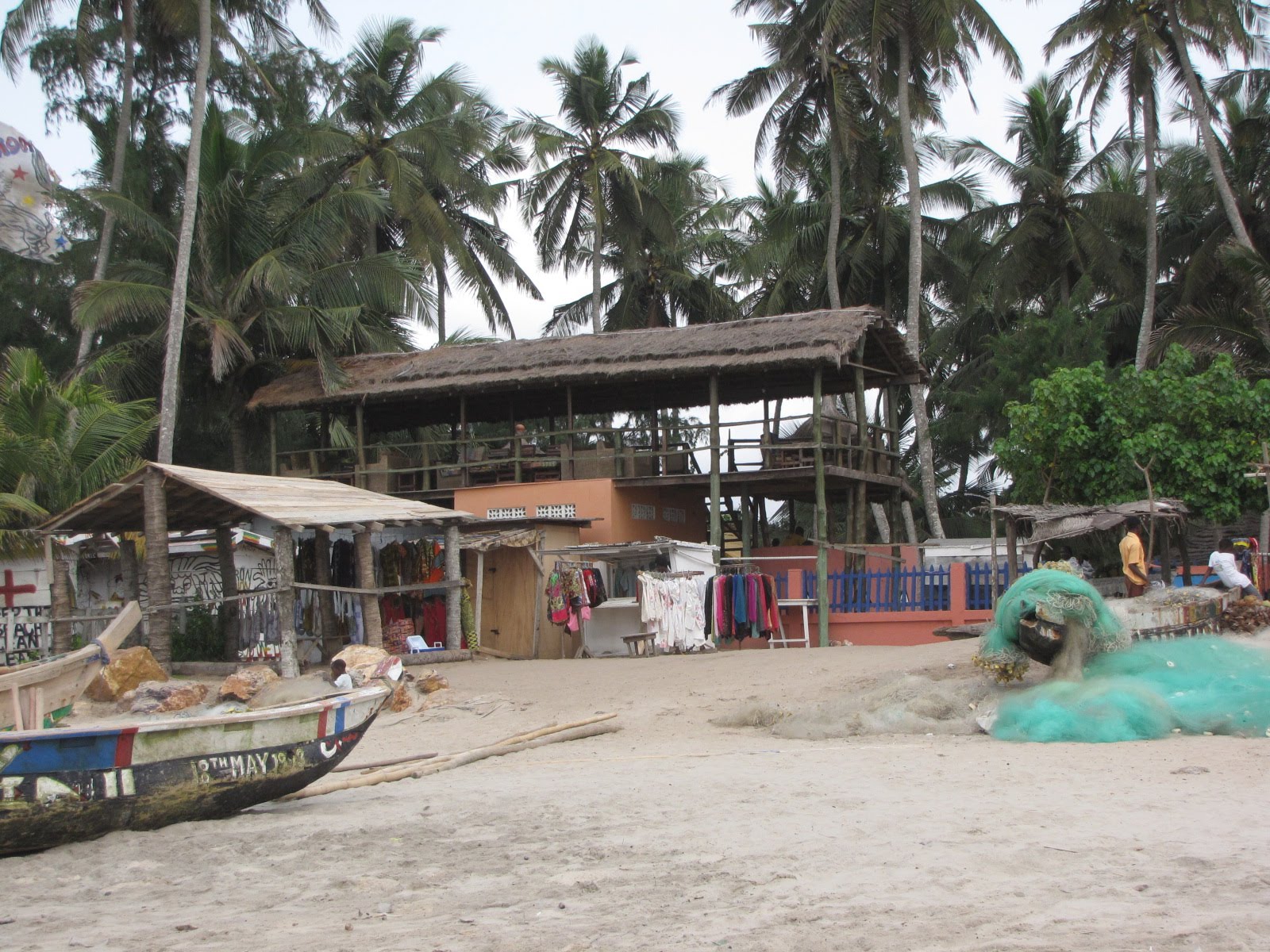
The place was right by the beach and is a popular haunt for NGO workers taking a break from Accra and young volunteers ready to party on the weekends. We had a nice clean room with a fan and bathroom but it was very hot. The foam bed made sleeping even hotter. There was an outdoor bar where a lot of locals gathered at different times of the day. There was a separate cocktail bar where the juices and alcoholic cocktails were made. The restaurant overlooked the beach and we had to choose one of the five dishes on the menu and eat at 6.30 pm. A lady had a small kiosk where she sold sweets and snacks while dotted around the car park were several souvenir stalls run by locals.

View from the beach

The place was started 17 years ago by a British lady and she has stopped extending the place and is now working on beautifying it. Outside the fence that separated the yard from the beach, were lots of small higgledy piggledy built shops where the locals sold jewellery and clothes. In the evening the Rasta men would gather and smoke cannabis and the young men would come and kick their football in front of the yard gate while showing off to the female volunteers they could see relaxing above the cocktail bar. I found it a strange set up.


We were warned not to walk along the beach to the left as there were some "bad boys" there. When we walked to the right we saw several other guest houses but none with souvenir stalls like outside ours.

The cocktail bar with the deck where we could watch the sea and the locals watching us.


Most of the locals are involved in fishing and everyday could be seen repairing nets, fixing boats, heading off to fish, or bringing in fish. The beach was littered with plastic bags and rubbish and the sea was rough with an under-tow so it was not good for swimming while we were there.

On the weekends there are drumming, singing and dancing activities and the place is busy. We were happy to use the guest house library to swap our books and relax after the frenetic pace in Accra. We arrived after the weekend so it would be quieter.

From here we were told to catch a shared taxi (minivan) to the junction with the main road but the tro tro driver decided to return us to the main tro tro station in Accra. He did however help us find a comfortable air conditioned bus to go to Cape Coast.


Accra, Ghana

Preparing for our entry to Ghana took a lot of time in Addis. We had read forums where people were turned back at the airport because they didn't obtain visas before arriving. As there is no Ghanaian Embassy in NZ our passports would normally go to Sydney and be processed by the embassy there. We read the information on the Ghanaian immigration site and it said only emergency visas were issued on arrival at the airport and then these were only with the permission of the Foreign Affairs office. We contacted the embassy in Addis who told us they couldn't issue visas to foreigners. We contacted Sydney who told us they had never heard of having to get permission for a visa.

With all the information we had found, we decided to cover ourselves with all the documentation we could to make it easy to get a visa at the airport on arrival. We had copies of a letter from the bank stating we had sufficient funds. We bought a fully refundable flight ticket to show onward travel. We copied the relevent emails from the embassies we had contacted. We booked accommodation in Accra and had a copy of a letter of invitation from the accommodation place to say we had bookings there. Then we crossed our fingers!

We had to get an early taxi for our 8.30 am flight. We were the first to check in and had to wake the dozing clerk at the desk. The airline, Ethiopian Airways, were not worried that we didn't have a visa and only wanted to know we had an onward ticket from Ghana.

The plane was not as modern as the ones we flew with internally but it was OK. There were TVs in the aisle and that was the only entertainment for the six hour flight. There was a noticeable number of Chinese men on the flight who were the last to turn off their cell phones before the flight and the first to turn them on on landing, probably business men rather than tourists.
On arrival we went to the visa desk and filled in a form, paid $150 US each and were given a 30 day visa without having to refer to any of our documents. Expensive but no hassle!


The ride we had been promised didn't arrive to pick us up at the airport so we had to buy a local SIM card and call the guest house. The owner told us to wait out front and then we were picked up by a driver. 45 minutes later we were at the guest house only to be told that there was no room for us, although we had a letter from the owner confirming our room nine days ago. We were offered the daughter's room but it was full of personal stuff. This is always a worry if something gets broken or goes missing so we declined it. We were taken to another place a short drive away but it didn't have the facilities we wanted and catered for long term accommodation for young gappers doing volunteer work. We insisted they took us into the city where we would find a more reliable place in a more central location. "This is Africa" they said but we have never had these problems in eight months, it is not the Africa we have experienced.

The taxi driver took us to the Methodist Church guest house but it was full and we were able to make a booking for the next day. We found a cheap hotel that was a reasonable price and a short walk from the guest house. There was no electricity when we arrived and then the generators all started up. Lots of places have generators on the footpath so electrical outages must be commonplace.

The temperature at 30C and humidity at 70% took some getting used to after the cool temps of Addis. We were able to find somewhere to eat before going to bed and worked out that we had crossed three time zones.

Accra has close to 3 million people and we headed into the Makola Market. A hot, steamy, bustling place jammed pack with everyone trying to make a living selling anything they can. There were no supermarkets nearby so we had to buy from stalls where the whole street was dozens of little shops with groceries and the products spilled onto the footpath and over the drains and onto the edge of the street. There was barely enough room to walk especially when the deliver trucks arrived to drop off goods and the truck took up the remainder of the street space. The women on the streets sat in the middle of their stock and could reach everything piled up around them with out leaving their seat.

Stereos were blasting out local music and when I danced to the beat the women cheered and a couple of them joined in following me as we all danced down the street and everyone had a great laugh. What a happy bonding feeling after the reserved Ethiopians.

We had a terrible time waiting in queues at communication companies trying to get a SIM card for our dongle ( mobile modem ) so we could get back online. As it was a Saturday, the weekday staff were off and the fill in staff had no idea what we wanted nor how to get it for us so we had to return and queue again on Monday as shops shut on Sunday.

There are not many tourist sights in Accra so we walked around the city near the waterfront. This monument marks the country's independence from the British in 1957. We will be in Ghana for the Independence Day celebrations but maybe not in Accra. The black star is on the flag and the name of the national football team.


A huge stadium has been built near the black star monument, and this section where the president will preside over the events, was being painted in readiness.


Not far from this was the Eternal Flame of African Liberation but it had gone out!

We had to be tough with some of the touts who wanted to herd us into their craft shops near the beach.


This poster on the side of the road was interesting. The logos at the bottom show the countries that give aid to such projects. (double click on the photo and it should enlarge).

About 70% of the population are Christians, many of the charismatic and revivalist persuasion, while 15% are Muslim. However, many people mix their religion with the traditional beliefs, in the form of spirits and gods of the natural world. Worshipping ancestors is also an important tradition. As the European missionaries introduced Christianity and education, there are a tie up between education and religion. Most of the schools we have seen are church run.

Ghana is known as "Africa for beginners". It was also the first country to welcome Peace Corp volunteers introduced by JF Kennedy in 1961. Now there are dozens of volunteers from many countries in Ghana.

We will explore other parts of Ghana and return to Accra to get visas for some of the surrounding countries

Addis Ababa, Ethiopia.

Returned to Addis for the last time. We had left our camping gear at the guest house and spent a couple of nights getting organised for our flight to Accra, Ghana. Air Ethiopia had changed our flight time about 3 times and the times got earlier and earlier. Luckily we were able to go to the office and check the evening before we flew.

John had his eye pressures taken again and they were fine although the optician used an old fashioned meter to test them.

It was really cheap to get our photos burnt onto a disc, less than a dollar!

We ate at our usual haunt and caught up on the people we had met there. We were surprised to meet Manchester Mike again. He is a young guy who had his wallet taken while in a minivan back in December. He had his passport and credit cards taken too. Through the consulate he was able to get the passport. But the most difficult thing for him to do, was to get PIN numbers on his cards. That took the longest to sort out as you are supposed to go into your bank and do it. All that time he was unable to get money and had to rely on friends to help him out. Finally that was done and he was ready to fly home but once he got to the airport he was told he didn't have an entry visa in his passport so he couldn't exit. The documentation that they had arranged through the consulate was not adequate so he hadn't been able to leave and wouldn't be able to until the end of March. In total he was stranded for 4 months. Unbelievable!

There were lots of new faces at the hotel and most of them were Israeli. One of the men was over 60 and married a young Ethiopian girl. Every few weeks he flew back to Israel where he bought bags of label second hand clothes. He set up his suitcase on the footpath and sold the clothes. He was trying to set up a business in Addis.

We caught up with Asaf, a young Israeli guy whose family had adopted an Ethiopian lad. Asaf had travelled up north to take photos of the son to his family who had not seen him for eight years. He had a wonderful and emotional time with the family in their small village.

All through the parts of Africa we have been there are lots of different ways of greeting people. Some people here kiss on the cheek 2 or 3 times. Some shake hands while others hug and pat each others backs at the same time. Ethiopians have a shoulder hug. They shake hands and then press their shoulders into each other. It looks so awkward when do it, if one person is sitting down, or if one is much shorter than the other. The more shoulder hugs the closer the friendship but it was only used by men.

In some places we saw people shake hands and then the younger person would kiss the older person's hand and hold it to their forehead, sometimes it was done 2 or 4 times.

It took a little time to get used to the traffic, the crowds, beggars who target the tourists, touts, diesel fumes, crazy drivers, street and footpath obstacles, street traders, bargaining taxi drivers, and the urine smelling streets of Addis and on our final stay it didn't feel as chaotic as on our first day.

Monday, February 28, 2011

Harar, Ethiopia

From Hargeisa, Somaliland, we caught a shared taxi, a station wagon, the back was loaded with two mums with babies on their back and two men. The back seat had four people and John and I were crammed into the front seat by the driver. The bags were loaded onto the top and we headed off for the Wajaale border town. The main street was under construction and the rest of the place was dirty and dusty with lots of makeshift stalls lining the roadsides. We were told by our travel friend Andy that we would have to pay $20 US for an exit tax but the man in the immigration office stamped us out of Somaliland and wished us well.
Several touts directed us to a bus that was quickly filling up and when we were five people squashed into the four seats across, with more sitting on the entrance steps, we headed off. Passed through lots of police check points where we all had to get out. At one stop the police wanted to check my backpack on the roof. I had padlocked all my zips so he couldn't get in and after undoing buckles and lifting off the lid he gave up. The boy who loads the roof had the job to watch the checks and then zip everyone's bags up again. Some police women checked all the plastic shopping bags that were left inside the bus and even frisked some of the women passengers. Later we heard about an Italian man who was taken away from his group to a small shed where he was asked to pay a bribe, at this same check point. We continued a few kilometres and were checked again. Before each town and after it we were also stopped.
Not far from our destination, Jijiga, Ethiopia, we could smell a burning smell and we had to stop and replace a wheel bearing. Luckily they had spare parts and it was all done in no time.
At Jijiga, we changed to a large bus just as it started to get dark. We left with a few empty seats but picked up people along the way. We drove through some towering rock mountains that looked like someone had piled giant rock sculptures on top of the pinnacles and cliffs. It was a smooth trip on a sealed road.
In Harar we found a hotel near the bus station and had to walk through the crowds of women selling fruit, vegetables, food, and clothing along the street. We were able to eat at the restaurant and look down over the market area below.
Harar is a World Heritage site with a walled city. In just one square kilometer, there are 368 alleyways, 87 mosques and shrines, as well as shops, houses, and government buildings.
One of the five old city gates.
One of the lanes with a bougainvillea bush.


One of the circles in the old city where these old taxis have died and look forgotten.


Some people have painted their places in bright colours while others are left natural.


It took four men to lift this bag of grain onto this man's shoulders, then off he staggered.
One of the strange things that happens here, is the night feeding of hyenas by some of the men in the town. According to our guide book, 'it's not a touristy show, it's a tradition'. We met people who had to pay to see the show and saw tourist posters showing the men with entrails in their mouth that the hyena took from them. It was pretty expensive and we had seen enough hyenas in our travels so we didn't bother to go. One of the local touts who wanted to be our city guide told us they feed them so that they will leave the farm animals alone. During the Epiphany celebrations the hyena don't come to eat as the locals give them food when they slaughter animals for the feast.
There is a lot of qat grown in the area so in the afternoon the men sat around chewing the leaves. The city centre is very pleasant and clean. There are wide streets with huge jacaranda trees providing greenery and shade. At night there were very few street lights in parts of the city but it felt safe to walk about. In the evenings we met up with Carlo from Italy, who lives in Nepal, and an Australian woman who gave her boys to her ex-husband and will spend two years doing tours in Ethiopia.
We found a pleasant restaurant with a huge choice of dishes and were able to see the news of the devastating earthquake in Christchurch, NZ. The internet services in Ethiopia are woeful so we could only check on the internet when there was a connection and then we were lucky if we stayed connected for longer than 15 minutes at a time.